1. Our spinning equipment and its functions --- imported from Japan
Fearnaught machine: It is used for pre-loosening and basic mixing of the after-drying colored cashmere fibers.
Carding machine: It is used for complete and thorough loosening and mixing of the dyed cashmere. Passed through several carding cycles, a wool net is formed. The thickness of the whole wool net is even, all cashmere fibers keep in straight line at uniform density. Finally, at the outlet end, the wool net is divided into multiple strands, each of which is twisted into strips, and then wound onto the yarn reels.
Self-actor mule: The strip roving produced by the carding machine is fed, drawn and twisted by self-actor mule, and finally made into the main yarn product, namely tube yarn.
Winding machine: It is used for transferring the winding of each tube yarn to a larger pagoda-shaped bobbin that meets the specifications of the finished product.
Doubling machine: It is used for combining of two or three single yarns produced in spinning process into double or three strand barrel yarn.
Double twister machine: It is used for twisting the yarn after doubling to make it meet the required twist and become the final product.
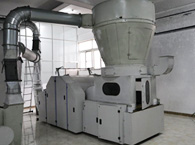 | 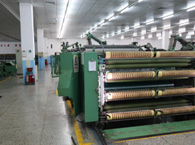 |  | 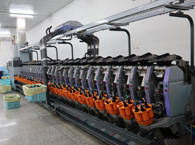 | 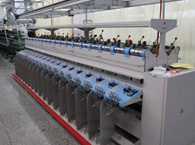 | 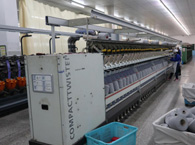 |
Fearnaught machine | Carding machine | Self-actor mule | Winding machine | Doubling machine | Double twister machine |
2. The environment of our spinning plant --- constant and controlled temperature and humidity
Our spinning plant is equipped with central air conditioning equipment. The internal environment is kept at stable temperature and humidity range all year round, in particular, it is crucial that the relative humidity is kept at about 70 degrees. This ensures that:
(1) The physical hygroscopicity and dehumidification of raw materials are not affected by the changes of external environment so as to prevent static electricity or fibre winding during the carding process.
(2) Stable temperature and humidity help ensure the product quality (thickness and fineness) of spun yarn and avoid defects in the process of yarn production.
(3) The relatively steady temperature and humidity ensure uniform thickness of the yarn shaft, consistent yarn twists, and stable appearance and physical indexes of cashmere yarn.
(4) Ensures moisture regain rate of the finished yarn --- at 15% --- relatively stable.

 English
  中文
中文 