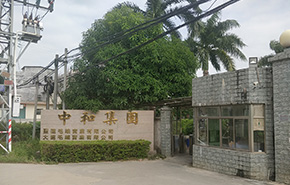
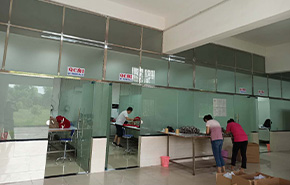
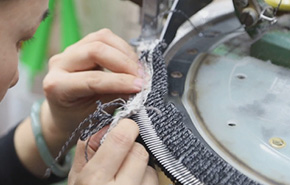
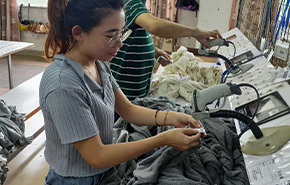
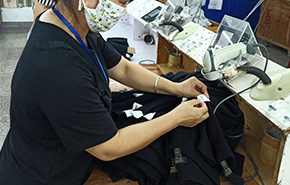
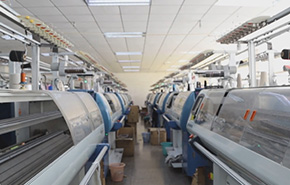
Our garment knitting production is handled by three garment factories set up in Guangdong and Myanmar. The cashmere knitting production processes are generally as follows:
Raw material examination and pre-treatment process:
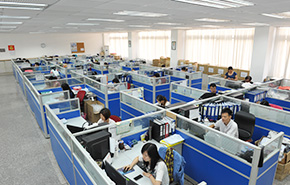
The factory inspection department carries out sampling inspection on the yarn put in storage. The test items mainly include calibrated linear density, evenness of yarn body, number of twists and their unevenness, breaking strength and elongation also their unevenness, moisture regain, smoothness and softness, color difference and uneven dyeing defects, so as to adjust the production process on different incoming raw materials. The incoming cashmere yarn will generally go through the winding process to improve their tension and remove any minor miscellaneous defects on the yarn. During winding process, wax, oil or emulsion will be applied to cashmere yarn to reduce its friction coefficient and thus more suitable for knitting production.
Knitting process:
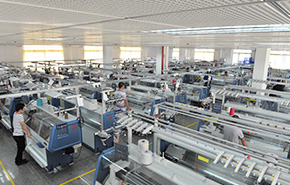
At the first step, we use the advanced computerized flat knitter for panel knitting. Before knitting starts, experienced technicians will set up craftsman’s drawing and production parameters on each machine, then the computerized flat knitting machine automatically works to knit the wound barrel yarn into semi-shape clothing panels.
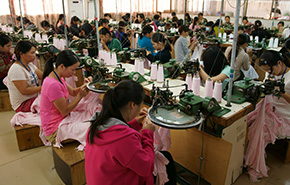
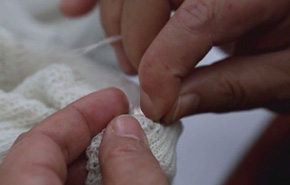
Then, the semi-shape clothing pieces are sewn up mechanically and manually. In addition to the sewing process, there may also be embroidery, tie, applique, printing and other production steps, as well many finishing steps such as feathering or milling processes. Our cashmere products also go through very special finishing processes such as anti-pilling, anti-shrinkage and anti-moth treatments.
Finishing process:
The hand-feel of a cashmere sweater largely depends on the washing technique. A professional washing technologist is able to deliver soft, comfortable and skin friendly cashmere products.
The following processes are also required after garment forming but before leaving the factory: repeated inspections, ironing and shaping, trademark sewing, rechecking, measurement, packaging and warehousing. All of our products are required to go through all these final Quality Control processes before leaving the factory.

 English
  中文
中文